Thirty-nine gubernatorial elections sit on the 2026 calendar, and roughly twenty-one incumbents are term-limited or otherwise not seeking reelection. That means at least twenty-one governors’ offices are guaranteed a transition before the 2027 governing cycle begins.
My last post was advice to incoming CIOs about what an individual leader can do in their window. This is the companion piece: what the rest of us owe those governors before they’re sworn in. Philanthropy, civic tech, the digital service movement, alumni networks, policy shops, and funders can either hand them nine disconnected pilot ideas or a coherent stack of installable capacity.
Too many states relearn the same lessons from scratch. They hire too late, procure too slowly, over-trust vendors, under-use resident feedback, miss federal funding, and treat delivery as a strategy problem when it’s actually an installation problem.
Jen Pahlka’s argument in Recoding America has been stuck in my head: better tools don’t fix government delivery. The systems and structures around those tools do. Implementation is what gets undervalued. We have tools. What we don’t have, in most states, is the operational capacity to use them.
- Talent pipelines that match the work to the people who can do it
- Feedback loops that put resident reality into delivery decisions
- Delivery frameworks that move from project to product
- Permission structures that make modern work legal and political
- Peer networks that move pattern recognition across state lines
What’s Different About 2027
When we founded the Colorado Digital Service in 2019, three things weren’t true that are true now.
First, the technical landscape changed. LLM APIs are now mature enough for well-scoped, auditable triage and analysis workflows: regulatory review, document analysis, correspondence routing, benefits navigation, internal knowledge management. Standards like the Model Context Protocol (MCP) give AI-enabled applications a more consistent way to connect to tools, data, and workflows. MCP is an open standard for connecting AI applications to external systems. But in government, the hard part is never just connection. It’s authorization, privacy, auditability, service ownership, accessibility, and maintenance.
The opportunity isn’t “build civic apps without government.” The opportunity is to create secure, public-interest interfaces that let agencies, civic technologists, and residents work from the same service layer.
Second, the digital service movement grew up. In 2019, we were still arguing whether digital service teams should exist. Now we have a decade of evidence from the legacy of USDS, 18F, Presidential Innovation Fellows, Code for America, U.S. Digital Response, state services in California, Colorado, New Jersey, Georgia, and city services in dozens of places. We know what good looks like. We have alumni. We have playbooks. The question shifted from “can this work?” to “how do we install it durably?”
Third, the discourse changed. Recoding America did real work. Statecraft and Niskanen Center papers have given language to public capacity that works across ideological lines. The Ohio AI regulatory cleanup made the news. New Jersey’s unemployment insurance modernization is studied. The political cost of arguing for modern government delivery is lower than it’s been in my career.
These shifts mean the 2027 transition isn’t just another transition. It’s the first one where we can hand a governor a coherent stack and reasonably expect them to install it.
OK, the stack.
1. Double Down on the Tour-of-Service Model
Thesis: the talent problem in government is usually framed as a pay problem. It’s also a permission-structure problem.
The federal model proved this. USDS, Presidential Innovation Fellows, and 18F brought people in for defined missions, often for two-year tours, and sent them back to industry with their reputations enhanced. The pay was below market. The talent that showed up was senior and scarce. Why? Because the structure matched how technologists, designers, product leaders, and delivery people actually plan their careers. They could commit to a mission without committing to a career path.
At Colorado Digital Service, we informally borrowed the same model: two-year terms, defined deliverables, work that mattered. People across Colorado from important tech companies like Twilio, Pivotal, Google, and others raised their hand offering to help.
What states need before inauguration:
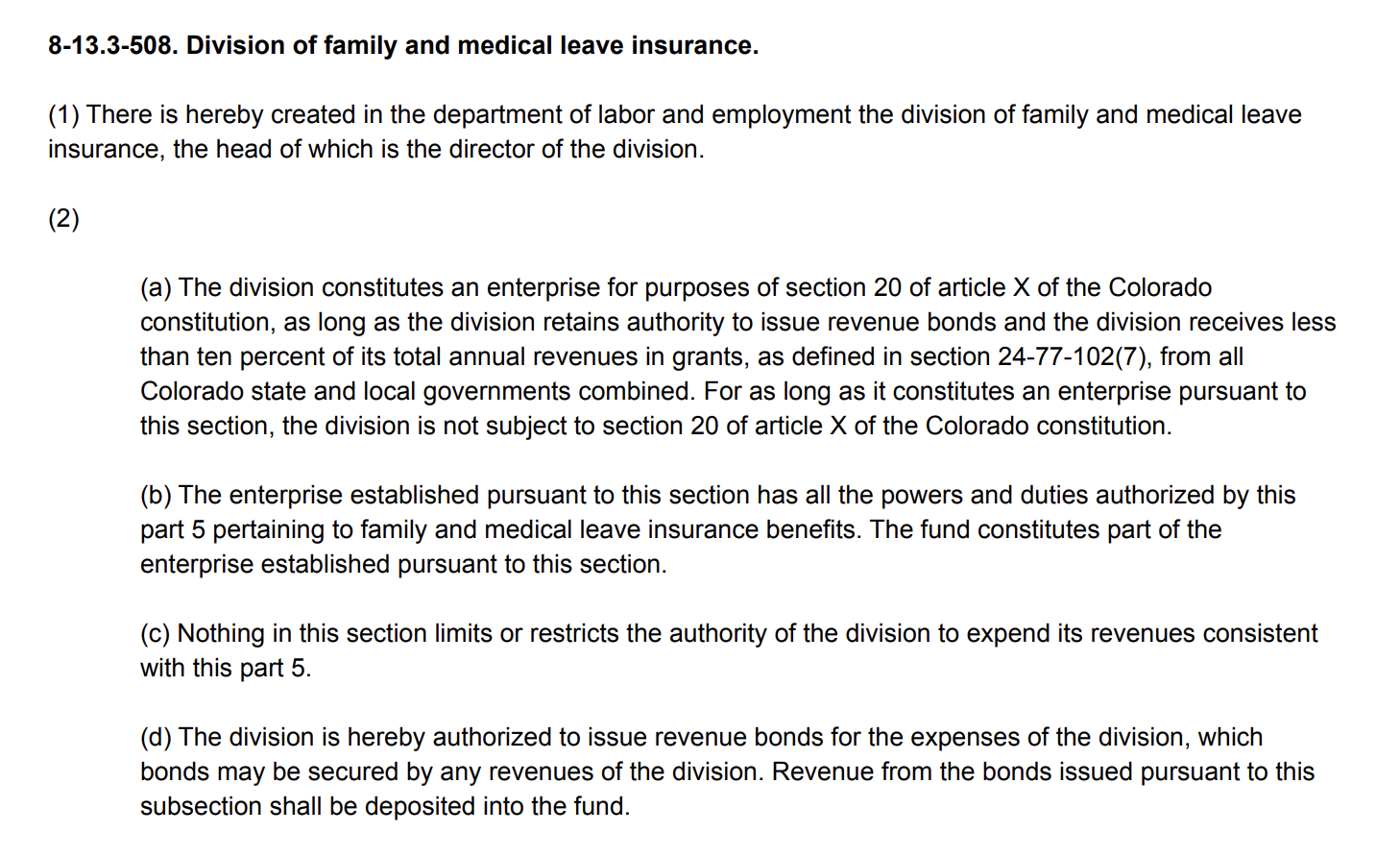
- Authority: executive order, special hiring authority, or another legal mechanism to create tour-of-service roles outside normal classification.
- Funding: a four-person cadre costs roughly $800K to $1M annually all-in. That’s small in a state budget but a real ask for a governor’s office.
- Mission scoping: vague missions kill tours of service. “Modernize unemployment intake,” “launch paid family leave,” or “ship the licensing portal” works. “Help with digital transformation” doesn’t.
- Build alumni infrastructure. Make public service a resume enhancer.
2. Invest in Resident Voice Infrastructure
Thesis: most government delivery is built on what staff assume residents want.
The People Say offers a useful model: a qualitative database designed to help policymakers hear directly from the public when shaping policy. Today it focuses on older adults and caregivers and is a collaboration between the Public Policy Lab and The SCAN Foundation. The 2027 opportunity is to adapt that model to state delivery domains: benefits, licensing, workforce, childcare, tax, permitting, and health.
The technical idea is straightforward. Structured qualitative research at scale, with stories tagged by domain, demographic, life event, service journey, and pain point. A team working on workforce benefits can hear from people who actually applied. A team designing a licensing portal can hear from residents who got stuck. A team modernizing childcare benefits can see how the same family navigated eligibility, documentation, language, and timing across programs.
Every delivery team has a backlog. Every backlog gets prioritized somehow. Right now, in most agencies, prioritization is dominated by statutory deadlines, vendor proposals, compliance anxiety, and internal politics. Resident voice gives product managers a competing input. It changes the meeting. It’s a key input into any Product Ops flow.
Why this scales:
- Stories have long shelf life.
- Patterns compound across domains.
- Marginal cost falls as tooling and methods mature.
- Resident input creates legitimacy if consent, privacy, and reuse are handled well.
3. Bring Back Brigades, or the Civic Tech Distribution Channel by Another Name
When we founded Colorado Digital Service, the Denver Code for America brigade was one of our recruiting sources and a great group of folks to talk with about our plans for the team. People came to brigade events because they wanted to do civic work.
In the years since, brigades have weakened. Code for America itself changed its formal relationship with brigades, and many local groups had to rethink sustainability, funding, and affiliation. Branding matters less than function. What’s been lost is the local civic tech distribution channel where energy concentrates and talent finds its way into public work.
What’s different now:
- Open datasets are more common.
- Open source is no longer exotic in government.
- Standards like MCP and adjacent patterns are lowering integration friction.
- AI has made small teams dramatically more productive.
- The alumni network from digital service work is large enough to seed local ecosystems.
But the rebuilt brigade shouldn’t be a hackathon factory. It should be a maintainer network.
The goal is persistent civic infrastructure: open-source components, documented APIs, service journey testing, agency-adjacent prototypes, local delivery research, and talent pipelines into public roles. The best projects should have maintainers, agency relationships, and a path to adoption or graceful retirement.
Failure mode to avoid: recreating volunteer organizations that build throwaway apps no one owns. The new civic tech channel should concentrate energy, create relationships, and move talent into the stack.
4. Run Workshops That Create Permission Structures
In 2017, Robin Carnahan and Waldo Jaquith came to Colorado on GSA 10x funding. They ran workshops on agile delivery and procurement reform. Legislators came. Agency heads came. CIO staff came.
Watch Waldo’s famous testimony to the Michigan State Legislature.
What changed because of those workshops in Colorado?
The legislature started asking agency directors better questions about IT projects. Their oversight tightened. CDS got political cover to experiment with procurement. Agencies got political cover to try iterative delivery. Shared language emerged. “Modular procurement” stopped being jargon and became a thing the budget director could ask about.
That’s permission-structure work. Workshops are an unreasonably effective way to do it because they change what powerful people know how to ask for.
The 2027 playbook should include workshop bundles for new governor transitions:
- Agile delivery and the difference between project and product
- Modern procurement, modular contracting, and outcome-based solicitations
- How to read a technical proposal and ask vendors the right questions
- Case studies from Colorado, New Jersey, Ohio, Pennsylvania, and other states
These should be free to transition teams and delivered by practitioners with skin in the game. This may be the highest-leverage workshop work we can do, and it’s astonishingly underfunded relative to its impact.
5. Publish the Salary Reallocation Playbook
I have not actually run this play myself, but it’s one of my favorite ideas here.
The problem is simple. State IT positions are often classified around $75K to $130K. Market rate for the senior engineers, product managers, designers, data leads, security specialists, and delivery leaders we need is often much higher.
But there’s a move many agency heads may already have, or can request, authority to make: combine vacant positions within a functional area to fund a higher-paid single position, holding total appropriation flat.
Example:
- Before: two vacant IT classifications at $130K each, unfilled for 14 months.
- After: one senior product or engineering role at $200K, tied to a named mission.
- Fiscal impact: appropriation stays flat.
- Operational impact: the agency gets one senior person it can actually hire instead of two mid-level positions it can’t fill.
Steps to actually pull this off:
- Legal review and authority templates for each state
- Classification rewrites for senior engineer, product manager, designer, security lead, data lead, and delivery manager
- Talking points for the budget office, legislature, public employee unions, and press
- Failure-mode mitigations for union objections, legislative pushback, and classification disputes
Every state that adopts this potentially unlocks better hiring without needing a new appropriation.
6. Build Federal Funding Optimization Tooling
In Colorado, the Office of Federal Funds and Strategic Initiatives is a small team with an oversized return. Its mission is simple: track federal funding opportunities, match them to agency needs, help agencies apply, and optimize drawdown.
Without this capacity, states miss discretionary grants, matching programs, and implementation funding. They also miss the intelligence layer: which grants are worth chasing, which agencies are ready, which matches are feasible, and which federal opportunities align with the governor’s delivery agenda.
The chicken-and-egg problem is real. A state without a federal funds office often doesn’t have the budget for one. External seed funding can break that loop.
Steps:
- Seed funding for a one- or two-person federal funds office in any incoming governor state that wants it
- Shared infrastructure: a federal opportunities tracker scanning grants.gov, agency announcements, and relevant federal updates
- A peer network of state federal funds officers
- Training on federal application and drawdown workflows
After 24 months, many states should be able to fund the office from the federal capture it helped generate. The seed is finite. The return compounds.
7. Open-Source AI Regulatory Cleanup
State regulatory codes are archaeological sites: references to defunct agencies, expired sunset clauses, contradictions between newer statutes and older regulations, broken cross-references, and definitions of “modern technology” that name obsolete tools.
Ohio’s AI-assisted regulatory cleanup showed why this is politically interesting. Reporting described AI helping identify outdated or redundant parts of Ohio law and regulation, with human review built into the process, and the state has said the tool removed more than two million words and rescinded nearly 900 rules from its administrative code.
What the tool does:
- Ingests a state’s digital regulatory code
- Flags temporal markers, expired authorities, and obsolete provisions
- Finds broken cross-references and references to defunct agencies
- Identifies duplicate or overlapping provisions
- Routes every flag to subject matter experts before any recommendation advances
The workflow matters more than the model. Every flag should be traceable to the regulation, prompt, source text, and review path. Every recommendation should show which human reviewed it and when.
The political framing also matters. This isn’t AI making policy decisions. It’s AI surfacing candidates for human review. That makes it useful to conservatives who want procedural cleanup and to liberals who want transparency, auditability, and better administrative maintenance.
8. New Gov Onboarding
An integrated offering for an incoming 2027 governor could look like this:
- Pre-inauguration: workshop bundle for transition team, agency heads, CIO staff, budget staff, and legislative leaders
- First 30 days: authority templates for tour-of-service hiring
- First 90 days: seed a four- to six-person delivery team using tour-of-service authority
- First 180 days: launch federal funds capacity and connect to the shared opportunities tracker
- First year: adopt the salary reallocation playbook, activate local civic tech infrastructure, and plug into resident voice infrastructure
- Year one and beyond: run an open-source regulatory cleanup pilot and foster an “ambassador network”
9. Create an Ambassador Program
This last idea came from a Claude webinar I joined today, focused on AI in state and local government, in which they encouraged folks to join the “Claude Ambassador Program“.
An ambassador program would be a state-specific network of technologists, civic tech alumni, government delivery experts, procurement reformers, product leaders, designers, data leads, and policy operators recruited explicitly to “give first” and help agencies. This is very similar to the incredible Techstars mentor network that was born here in Boulder, CO.
Steps:
- Recruit from USDS, CDS, 18F, PIF, Code for America, U.S. Digital Response, state digital services, civic tech companies, and government alumni
- Tag expertise by domain: health, workforce, benefits, licensing, procurement, hiring, data, security, AI, and product operations
- Maintain light infrastructure: directory, office hours, shared Slack, and a matchmaking function
- Add trust rules: conflict disclosures, confidentiality norms, and a clear line between peer support and sales
The point isn’t just helping individual leaders. It’s transferring pattern recognition across state lines. The mistakes Colorado made in 2019 don’t need to be made in Virginia in 2027. The wins California had in 2024 should propagate to North Carolina in 2027. Ambassadors can help.
What Could Break the Stack
This only works if we’re honest about failure modes.
A governor’s office can like the idea and fail to assign an owner. Philanthropy can fund pilots and ignore maintenance. Digital service hires can arrive without procurement, budget, or legal authority. Resident voice can become performative research instead of backlog input. AI cleanup can become a political stunt instead of auditable legal triage. Brigades can rebuild volunteer energy without sustained maintainership. An ambassador network can become advice without accountability.
Every one of those failures is predictable. That means every one can be designed against.
The stack needs owners, maintenance funding, authority, governance, trust rules, and a bias toward boring implementation.
Especially the boring parts.
Good Luck to the new Govs!
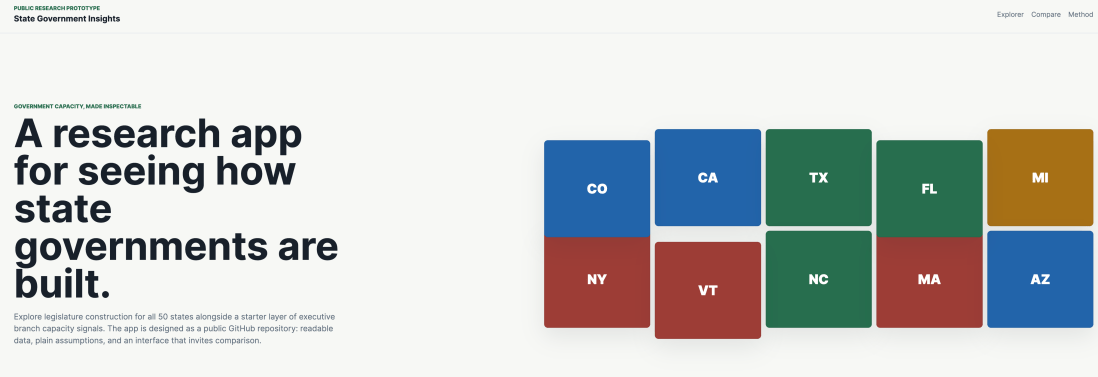
As I was researching and writing this post, I used OpenAI Codex to build a visualization to help folks understand differences across state governments and identify opportunities for capacity building. I used Perplexity AI to source data from state websites and Anthropic Claude to help me polish the blog post.
View the State Government Insights Dashboard and the supporting GitHub repository here.
Further Reading
Core frame. Jen Pahlka, Recoding America. Pahlka and Andrew Greenway, “The How We Need Now: A Capacity Agenda for 2025 and Beyond” (PDF).
Delivery and procurement. Robin Carnahan, Randy Hart, and Waldo Jaquith, “De-Risking Custom Technology Projects” and the “State Software Budgeting Handbook”. Statecraft case studies with Santi Ruiz.
Cautionary frame. Virginia Eubanks, Automating Inequality. Meredith Broussard, Artificial Unintelligence.
Operator frame. Jeff Lawson, Ask Your Developer. Brad Feld on complex vs. complicated systems.